
CTE Pathways: Engineering & Architecture
Mathematically and creatively inclined? A career in engineering or architecture may be just the ticket. Students will discover the careers available to them when continuing down these pathways and become career-ready for whichever option calls to them. Problem-solvers may especially enjoy the careers that await.
Engineering Pathway
In our Engineering Design pathway, students will build a foundation of engineering and architectural knowledge. In their third year along the pathway, students will have the opportunity to take a deeper dive either into aerospace engineering or civil engineering and architecture before coming back together for their capstone course.
Courses
Course Description
This course meets the University of California D-Science (engineering) requirements. This course also receives UC Honors credit.
YEAR 2: Honors Engineering Capstone
Course Description
Students will take their next steps to be career ready by learning about energy and power transfers, materials and structures, control systems and kinematics. Throughout the course, students will make calculations, conduct testing and come up with solutions to design problems.
For More Information
Frank Menjivar, CTE Teacher
fmenjivar@dusd.net
Outcomes
Mechatronic Pathway
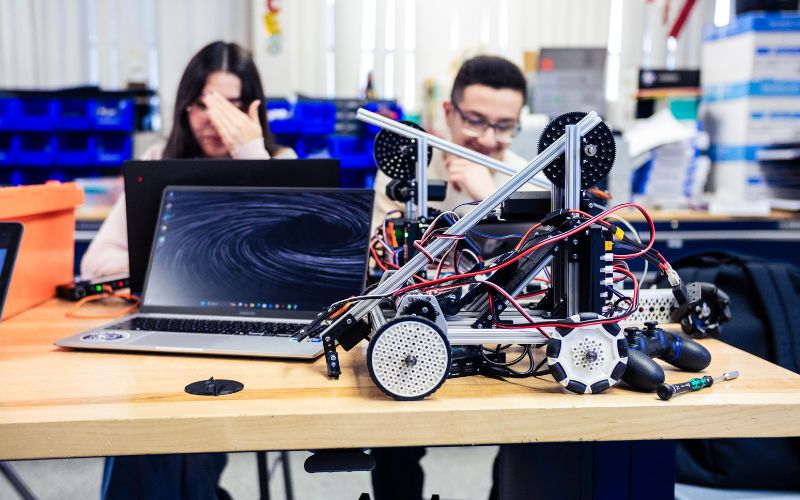
This one-course pathway provides students with a hands-on environment to work with technological systems. Students will dive into the engineering process, solving system problems with creative solutions. The pathway sets students up for success as they continue down the career path via academic, vocational or technical courses.
Courses
Course Description
This course meets the University of California D-Science (engineering) requirements. This course also receives UC Honors credit.
YEAR 2: Honors Mechatronics Capstone
Course Description
PCB design, CAD, CAM, open- and closed-loop control systems, and machine learning. Students will also explore additional advanced hardware and software techniques. The coursework is centered around hands-on, inquiry-based, cumulative projects in the laboratory setting. The projects focus on the application of physics principles in a variety of forms, including rotational mechanics, electrical engineering, computer science, and optics. Students will work individually and in teams to build, design, and test complex mechatronic systems. At the end of the course, students will complete a capstone project that combines many of these skills and document their progress and learning.
For More Information
Contact:
Aaron Tostado, CTE Teacher
atostado@dusd.net
Outcomes


Learn More: CTE Pathways at Warren
Each CTE Pathway is industry-focused and usually consists of 2-3 courses. The last course in the pathway is the capstone. When students complete a course they may receive college credit or receive an industry certificate. Click on each industry below to see details about the courses and outcomes.

Audio & Music Production

Audiovisual Tech Support

Biomedical

Construction

Education

Multimedia

Fire Science

Food Science & Culinary Arts

Game Programming

Machining & Forming

Sports Medicine

Welding
