
IBMYP Courses
Overview of Student Learning in IB MYP Subject Areas & Course Details

In each subject group, students will explore different courses that cover a broad range of topics, fostering both academic excellence and the development of key life skills.
Below, you’ll find a detailed list of courses within each subject group, along with course descriptions and grading criteria. This will give you a clear understanding of what your student is learning, how they are assessed, and the key concepts that will shape their educational journey.
Inside the Classroom
IB MYP students learn and engage in critical thinking by doing and experiencing. Subjects are not taught in isolation. Students are encouraged to make connections between subjects and not just memorize facts. This allows for a deeper understanding of the material.
Students in this program learn how to manage their own learning. They will organize and plan their work, meet deadlines, persist, and think positively. These valuable tools will continue to serve them beyond their academic career.
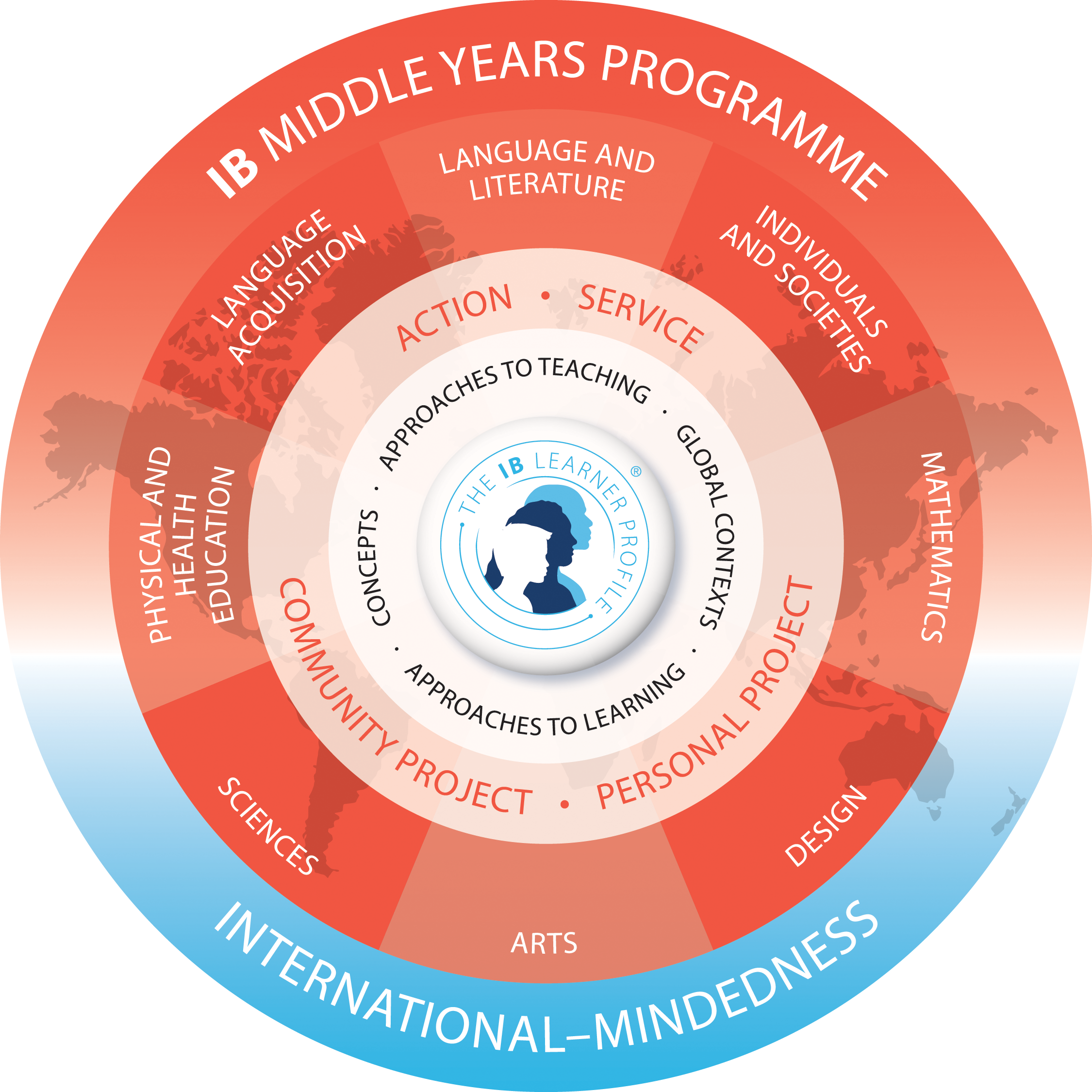
Approaches to Learning (ATL)
The IB MYP programme focuses not only on what students learn but how they learn. This special approach includes five major categories of skills that students will develop:
- Communication
- Thinking
- Social Skills
- Self-Management
- Researching
Students who continually work to develop these skills will be successful in college, career, and life.
Student Centered
Students are taught and encouraged to take ownership of their learning.
Students are given the opportunity to speak in front of others.
Students learn a second language, allowing them to engage with others in the increasingly global society.
Global Learning
The IB MYP Global Contexts allow students to approach content from a variety of perspectives.
Students observe and discuss significant global events and challenges.
Students are taught to understand and appreciate their culture and traditions while learning about others.
Grading with a Rubric
The IB MYP philosophy emphasizes holistic education, promoting not only academic excellence but also personal development, critical thinking, and intercultural understanding. Grading with a rubric aligns well with these goals and serves several important purposes and benefits:
Purpose of Grading with a Rubric
1. Clarity and Transparency: Rubrics provide clear criteria for assessment, making it transparent what is expected of students. This clarity helps students understand how their work will be evaluated and what they need to achieve to meet or exceed expectations.
Benefits of Using Rubrics
Subject Area & Course Details
Language & Literature
These courses focus on the study of language, literature, and literary analysis, helping students develop effective communication skills, critical thinking, and a deep appreciation for diverse texts and cultures.
Courses:
Language & Literature 6
Grade level: 6th
View: Learning Objectives
Language & Literature 7
Grade level: 7th
View: Learning Objectives
Individuals and Societies
This subject area explores the relationship between individuals, societies, and the world around them. It encourages students to investigate historical, geographic, economic, and cultural contexts while developing critical thinking and inquiry skills.
View: Criteria & Objectives
Courses:
Individuals & Society 6
Grade level: 6th
View: Learning Objectives
Individuals & Society 7
Grade level: 7th
View: Learning Objectives
Mathematics
The Mathematics subject area in the IB Middle Years Program encourages students to develop a deep understanding of mathematical concepts, problem-solving techniques, and logical reasoning, while applying their skills to real-world situations and global challenges.
Courses:
Mathematics 6
Mathematics 7
Sciences
This subject area fosters inquiry-based learning, where students explore key scientific concepts across biology, chemistry, and physics, developing critical thinking, experimental skills, and an understanding of how science impacts the world.
Courses:
Sciences 6
Sciences 7
Language Acquisition
Students have the opportunity to learn Spanish, enhancing their linguistic skills and cultural understanding through immersive language practice, communication, and exploration of the Spanish-speaking world.
Courses:
MYP Spanish 6
MYP Spanish 7
Grade level: 7th
View: Learning Objective
MYP Spanish 8
Physical & Health Education
This subject area promotes students’ physical, emotional, and social well-being, encouraging them to engage in physical activities, understand health concepts, and develop lifelong habits for a balanced lifestyle.
Courses:
PE & Health 6
Grade level: 6th
View: Learning Objective
PE & Health 7
Grade level: 7th
View: Learning Objective
Design
The Design subject area encourages students to explore creativity and problem-solving through hands-on projects. Elective courses like Digital Design 1 and 2 introduce students to digital tools and media creation, while Design and Modeling focuses on designing and building prototypes. Automation Robotics allows students to learn programming and create automated systems. These courses help students develop technical skills and creativity for the digital world.
Courses:
Digital Design 1
View: Learning Objectives
Automation Robotics
Competition Robotics
Grade level: More Info to Come
Arts
Students explore various forms of artistic expression in this subject area. Elective courses such as Beginning Band, Advanced Band, Jazz Band, and Marching Band offer opportunities to develop musical skills, while Art 6 and Art Design focus on visual arts, fostering creativity through drawing, painting, and design techniques. These courses encourage students to express themselves artistically while honing their technical skills and appreciation for the arts.
Courses: